Tuesday, July 8, 2014
OpEd on Common Core State Standards, Education and Juvenile Justice
You can check out my OpEd in the Chicago Tribune here where I articulate some of the successes and challenges of teaching the Common Core State Standards in my alternative education setting. Thanks to Teach Plus Chicago and the national Teach Plus team for helping me field the OpEd.

Friday, February 21, 2014
Professionalism and Assessment in Education: A recommended solution for a more professional approach to Performance Task Grading in Urban Schools
In the educational industry it is essential at times to demonstrate to a skeptical public the professionalism in education. Traditional and social media outlets recently have derided the educational profession. Much of this criticism is due to the tumultuous implementation of reforms driven by local, state, and federal governments over the past few years which disrupted traditional structures of education. It should be the goal of teachers to try to be honest with ourselves and our profession and embrace this moment as a time to steer the conversation away from negative pushback on accountability and student outcomes. Instead let’s take the opportunity to build a consensus of acceptance of the new reality and find solutions that we can come up with that meet and exceed the expectations our country, state, or district have now placed upon us. The more professional we are the more we legitimize education to skeptics of public education and assert more control over our profession. This is especially pertinent in regards to teacher evaluations and assessment, which is now inextricably connected with one another due to the Race to the Top reforms of the past five years and NCLB .
Many districts and states throughout the country have high stakes testing for students with serious implications for student and teacher evaluations based on growth and effectiveness. It is true that most states and districts have adopted multiple measures for student growth and teacher effectiveness. Education managers look to these scores to make important decisions including student placement in magnet or special schools as well as retaining or letting teachers go due to effectiveness, or lack thereof. It is necessary to analyze how assessments are scored and what measures constitute growth in order for these high stakes tests and evaluation systems to improve teaching and learning instead of being another failed reform effort. For large districts across the country, including Chicago Public Schools, these scores have serious ramifications for teaching practices and much is at stake, especially for teachers in regards to evaluations. Most are aware of the heated debate concerning the role assessments have and how scores are used due to the reforms adopted by Race to the Top federal funds. For example in CPS 25% of teacher evaluations are based on student outcomes which are comprised of teacher graded performance tasks and standardized tests given at the beginning and end of the year. These outcomes will be used to give value-added scores to teachers in order to measure effectiveness and in turn reward successes or warn ineffective teachers so that they can improve. This type of accountability is new to many teachers throughout the country, but due to new laws it is now an inevitable part of teaching, so it is best that teachers stop fighting this accountability and instead focus their attentions on raising the professionalism of education by leading the conversation on how teachers should be accountable, especially in assessment.
To have a more honest, transparent accountability structure it is important to note that often teachers are in charge of scoring their own performance tasks of their students at the beginning and end of the year in order to measure growth. The problem with this structure is that despite the rubric and professional expectations, teachers are still sometimes tempted to score students lower on the first performance task at the beginning of the year and then score the students higher at the end of the year to show growth. This may not happen at all, but it still gives the impression that there could be a lack of professionalism due to its tendency for subjectivity. One approach that would give more credibility to performance task scores is to have other teachers in a district anonymously grade other teachers’ students in a sort of swap. One way to do this effectively is to have teachers volunteer or be selected by the administrator(s) in a building based on previous history of high quality teaching and consistent positive student results. These effective teachers could receive a stipend for their work and could be department or grade level leads. These teachers would be given the responsibility of scoring performance tasks that have similar grade levels and demographics as their students. The teachers would have a different group of students to score at the beginning and end of the year and could receive specialized professional development at the beginning of the year to ensure that scoring is honest, transparent, and effective. This group of teachers would also be having their students’ performance tasks scored by others and it would be anonymous so there would be no fear or distrust of this process.
This would be a more transparent and honest scoring system that rewards effective teachers with additional responsibilities that include some compensation for their work on scoring performance tasks. It also provides an avenue for honest assessment that promotes teachers truly looking at their instruction and student outcomes instead of giving in to the pressures of high stakes testing by being transparent in the assessment process. It has an added bonus of providing another layer of professionalism to the educational sector. There are many complaints about teachers wanting to receive taxpayer dollars but unwilling to show results where most other professions are taken more seriously because they are results-oriented.
In our current educational milieu assessment is inextricably connected with teacher evaluations. In order for educators to teach effectively and students to learn successfully it is essential to reward effective teachers by giving options and financial incentives to receive more responsibility so they can remain in the classroom instead of being tempted to move to an administrative or district-level job. This is one approach that if applied will help retain high quality teachers by providing ladders of responsibility that can enable them to continue to be leaders without leaving the classroom.
Friday, May 17, 2013
Brief Thoughts on Criminal Justice...
For a good read on our adult criminal justice system check out
Michele Alexander's book The
New Jim Crow: Mass Incarceration in the Age of Colorblindness (click here for
an overview). You don't have to agree with all the views to admit that if our
country has more African Americans and other minorities locked up now than in
the height of South African Apartheid than we have a moral dilemma that must be grappled with. To me that is a problem that we all should explore and policy makers must address. For me it is an enormous human rights issue and based on my Christian convictions cannot be ignored.

I am a person with strong religious convictions and I believe
that since people are made in the image of God they should be treated humanely,
even if they committed atrocious acts. This compassion Jesus demonstrated when
people brought the adulterer to Jesus in John 8, "Whichever one of you has
committed no sin may throw the first stone at her." I don't condone any
crime and it is the job of the courts to judge offenders based on the facts,
but I still have compassion on others and do my best to treat people with human
dignity and respect based on the fact that all people are made in the image of
God no matter who they are. Even if people are found guilty and serve prison
time, they are still people who deserve the opportunity to contribute
positively in society. What do you think…?

Reflections on Juvenile Justice from Someone in the Front Lines...
"I am getting 15 years on Monday Mr. Miner" was a
statement my student said recently. The student is 15 years old and is looking
at this amount of jail time at his young age. On his 17th birthday his present
is that he will be woken up, shackled, and then transported to the Cook County Jail and placed in general population of the adult facility that is
notoriously overcrowded and the largest county prison in the country. Happy Birthday!


By the way, I try not to pay attention to the cases of my
students and I don't watch local news because I teach at a Chicago Public
School located in a county temporary juvenile detention center. The students that are
on the news will end up in my school and perhaps in my classroom and it is
better for me to teach them as a student without bias or preconceived notions.
I do know the student who made the comment above is not in jail for murder. Are
we rehabilitating Juveniles or abandoning them and letting them be lifetime
offenders who will be incarcerated for most if not all of their lives?

Illinois is in the process of changing laws for Juveniles to
have them stay in Juvenile facilities until they are at least 18 (see brief here from
the Illinois Juvenile Justice Coalition about this law in the process in
Springfield). I am not advocating being soft on Juvenile crime. As a matter of
fact as a person who teaches and interacts with juvenile offenders daily as
well as a Chicagoan who is raising a family within city limits I am definitely
for a strong Juvenile Justice system, the question is what is the goal of this
system? Is it rehabilitation or punishment? Instead it seems that the system
does both at the same time and then ends up with doing neither well. When we
figure out that rehabilitation and restorative justice is the goal of the
Juvenile Justice system, so that we have less teens becoming adult offenders,
we will be heading in the right direction. But by that time my student, who
will not be getting out for 15 years, will have already left the system briefly
and then returned as a repeat adult offender because our system was not sure if
we were punishing him or rehabilitating him. In my opinion I don't think you can do
both.
Thursday, April 26, 2012
Living Life through Second Life...
Imagine meeting people online via an immersive virtual environment for work, play, or romance. This happens every day. Second Life is the most influential of virtual worlds in our current technology landscape.

Second Life is a disruptive technology. It provides an avenue for people to communicate, live a digital life with less restrictions or inhibitions, work from home, build personal and romantic relationships. It can be a considered an immersive social network that can be used for business but is in many ways more of a personal expression. I think that Second Life is already in decline and will be replaced by other new communication and/or social networking tools that will incorporate but not only be limited to virtual worlds. I think that Second Life has limitations in K-12 settings due to privacy issues, restrictions and the inability to manage Second Life from a teacher's point of view. It may have limited use as a teacher-centered technology tool. One recent study about Second Life in K-12 and Higher Education can be accessed here. I think Second Life will be gone in 3-5 years facing a similar fate as MySpace, which is currently in steep decline.
Monday, April 9, 2012
Storytelling goes Digital and the Future of the Web...
Dr. Thornburg’s idea of the rhymes of history basically
states that many modern technological innovations echo previous ideas,
experiences, and/or cultural interactions from humanity’s past. Digital storytelling
through voicethread.com, storybird.com, or iPad apps such as StoryLines all
attempt to captivate the visual, auditory, and textual elements of
storytelling. The format for exchanging stories has changed throughout the
years; however the purpose of the stories remains as a collective approach to
share the human experience. Digital storytelling attempts to engage as many
senses as possible as a way to recreate in a sense the storytelling around a
fire among family, friends, and/or communities.
Kevin Kelly’s extrapolation of where the web is going in
his TED Talk “The next 5,000 days of the web” here
describes what it is evolving into a single, global machine and the web is its
OS (operating system). All of us together make up this machine and the web,
which has artificial intelligence but it is in and of itself not a singular
consciousness or entity, rather it is made up of all of the people and things
that are connected to it. He also contends that we will become codependent on
this Web as we are currently dependent on the alphabet and writing. Instead of
an alternate reality, this emerging web combines physical reality with digital
reality. Kelly reverses McLuhan’s statement “Machines are the extensions of the
human senses” to “humans are now going to be the extended senses of the
machine”. These ideas reinforce the connections, consciousness, and collective
consciousness of humanity and its perception of how it sees itself as a
collective, interactive, and dominant force in the natural world.
References:
Kelly, K. (2007, December). Kevin Kelly on the next 5,000
days of the Web [Speech].
Speech delivered at the EG 2007 Conference, Los Angeles. Retrieved fromhttp://www.ted.com/index.php/talks/kevin_kelly_on_the_next_5_000_days_of_the_web.html
Tuesday, March 27, 2012
Telephone Tetrad...
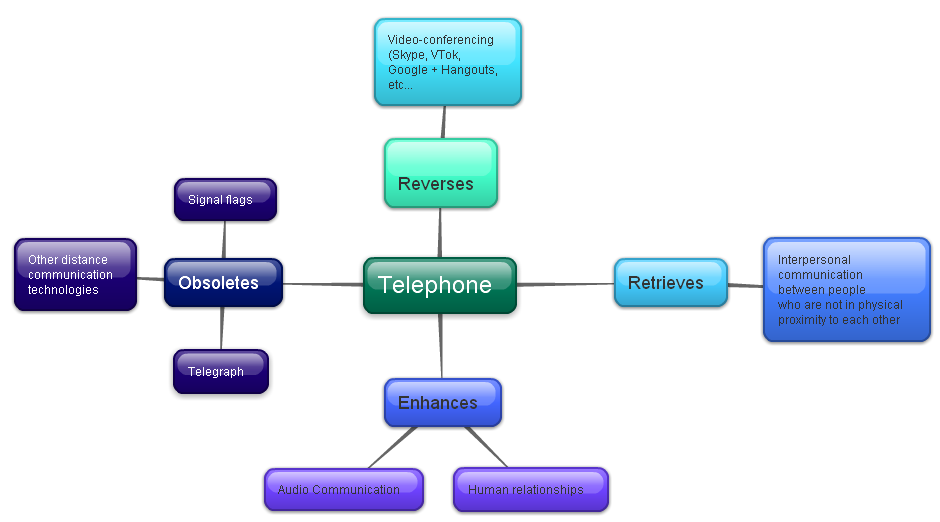
The telephone is an audio and communicative technology that
revolutionized human relationships. Telephones enhance audio communication and
human relationships, providing synchronous communication with one another that
transcends location. The technology tool reduces or eliminates the for distance
communicative technologies such as the telegraph, signal flags, among other
things. It retrieves the ability to continue to communicate with others who are
not in physical proximity to each other, therefore increasing connectedness of
interpersonal relationships despite geographical separation. Video-conferencing
technology tools such as Skype or VTok among the many others reverses the
telephone’s technological breakthrough because it replaces it with synchronous audio-visual
communication, which is in many ways superior to communication via exclusively
audio because interaction has oral and physical characteristics such as body language.
Wednesday, March 14, 2012
Digital Books as a Disruptive Technology
Identify a current technology that has emerged in the last few years that shapes learning or productivity in your industry.

According to Walton and Oestreicher’s (2011) presentation at the Eurasia Business and Economics Society’s Conference in June of 2011, accessed here, eBooks have just become “the single bestselling category in American publishing for the first time. The report from the Association of American Publishers also said that eBook sales in February were $90.3m, making digital book the largest single format in the U.S. for the first time” (p. 14). The reason for this disruption can be attributed to the rapid rise in netooks, tablets, and other mobile devices that very quickly proliferated throughout our society, as Reynolds & Ioffe’s (2011) have highlighted on the xplana blog post here. There projections for sales of digital textbooks can be seen on the chart. These and other important discussions about the role of eBooks as a disruptive technology, provide enough evidence that supports the fact that it is an emerged that eBooks/digital books are a disruptive technology in the education and publishing industries.

What problems or challenges have been associated with this technology?
The biggest barriers to textbook adoption have been the devices and formats that the digital books would be displayed on as well as the availability, distribution, and production of digital book content (Reynolds & Ioffe, 2011). The rapid adoption of Apple’s iPad, Amazon’s Kindle, and Barnes and Noble’s Nook among others in the tablet/eReader landscape has created a technological landscape that has mitigated these barriers to adoption because the devices and formats have been more or less created to cross platforms and devices. This has been the reason why this technological innovation has been so disruptive to publishing and educational industries.
What societal need does it meet, and what are its benefits?
Our current societal milieu has an increasing desire to have their hobbies/interests/entertainment be as mobile as they are in addition to the need to be digitally connected socially. The proliferation of digital devices such as tablets, smartphones, and netbooks has been created to meet this desire. The benefits of having any eBook that can be stored in the “cloud” of the Internet and be instantly pulled up at the whim of the reader has physical and psychological benefits. The physical benefits include the ability to have the reader’s entire library of books in digital storage so that they do not need to be physically carried around to be enjoyed at any time. The psychological benefits of searching books and downloading them for a cheap price any time there is an Internet connection is the ultimate satisfaction for the curious and intrigued reader. Both of these and other benefits serve the wants of the readers and the pocketbooks of the businesses providing these services. It is an inevitable result of our consumeristic and capitalistic ideals; instant gratification for a price that is right is considered a societal want which perceived as a need. Publishing companies must be able to provide this service if they are going to remain viable in our technologically savvy society. Companies that cannot provide this service, such as Borders, for example, will have to shutter their doors or downsize. This will make room for new technology-driven companies that can seize the moment and become an important player in the eBook market, such as Inkling, the up and coming digital textbook company and its Apps.

What would make this technology even better, avoiding the pitfalls you identified?
I think that eBooks and devices will continue to flourish and that libraries and other institutions must adapt to these emerging needs in order to remain relevant. The biggest challenges will include protecting copyrights, making eBook formats that can be accessed from multiple platforms and devices without sacrificing the visual needs of reading. Google and Amazon are among the companies who are able to meet these challenges at the moment, and other companies will also focus their research and development to make sure that they are able to compete.
References
Reynolds, R., & Ioffe, Y. (2011, March). Digital textbook sales in U.S. higher education – a five-year projection. The Xplanation. Retrieved from http://blog.xplana.com/reports/digital-textbook-sales-in-u-s-higher-education-%E2%80%93-a-five-year-projection/
Walton, N., & Oestricher, K. (2011, June). Google and Apple’s Gale of Creative Destruction. Presentation presented at the Eurasia Business and Economics Society, Istanbul, Turkey. Retrieved from http://worc.academia.edu/KlausOestreicher/Papers/770458/Google_and_Apples_Gale_of_Creative_Destruction.
Thursday, January 19, 2012
Storytelling goes Digital and the Future of the Web...
Dr. Thornburg’s idea of the rhymes of history basically
states that many modern technological innovations echo previous ideas,
experiences, and/or cultural interactions from humanity’s past. Digital
storytelling through voicethread.com, storybird.com, or iPad apps such as
StoryLines all attempt to captivate the visual, auditory, and textual elements
of storytelling. The format for exchanging stories has changed throughout the years;
however the purpose of the stories remains as a collective approach to share
the human experience. Digital storytelling attempts to engage as many senses as
possible as a way to recreate in a sense the storytelling around a fire among
family, friends, and/or communities.
Kevin Kelly’s extrapolation of where the web is going in
his TED Talk “The next 5,000 days of the web” here describes what it is evolving into a
single, global machine and the web is its OS (operating system). All of us
together make up this machine and the web, which has artificial intelligence
but it is in and of itself not a singular consciousness or entity, rather it is
made up of all of the people and things that are connected to it. He also
contends that we will become codependent on this Web as we are currently
dependent on the alphabet and writing. Instead of an alternate reality, this
emerging web combines physical reality with digital reality. Kelly reverses
McLuhan’s statement “Machines are the extensions of the human senses” to
“humans are now going to be the extended senses of the machine”. These ideas
reinforce the connections, consciousness, and collective consciousness of
humanity and its perception of how it sees itself as a collective, interactive,
and dominant force in the natural world.
References:
Kelly, K. (2007, December). Kevin Kelly on the next 5,000 days of the Web [Speech]. Speech delivered at the EG
2007 Conference, Los Angeles. Retrieved fromhttp://www.ted.com/index.php/talks/kevin_kelly_on_the_next_5_000_days_of_the_web.html
Laureate Education (2010) Rhymes of
History. Thornburg, D., Retrieved from http://sylvan.live.ecollege.com/ec/crs/default.learn?CourseID=6200933&Survey=1&47=6076761&ClientNodeID=984645&coursenav=1&bhcp=1
Sunday, January 1, 2012
Audio Tetrad: iPod
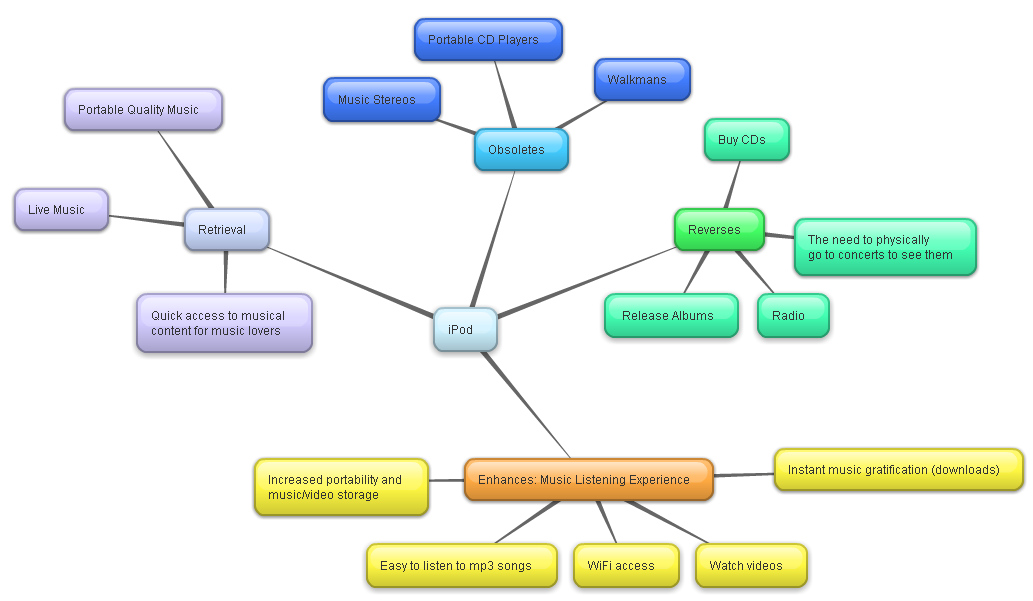
The iPod is the best example of an mp3 player which creates an audio
evolution that improves the aesthetic and musical quality with portability and
instant musical gratification. It enhances the musical experience through
instant downloads, portability, visual and/or auditory musical experience. This
device reverses the need for buying CDs, releasing complete albums, or the need
to go to a concert to see the video. iPods make portable CD players, music
stereos, and walkmans’ among other audio technologies. It retrieves/rekindles the
idea of live music but makes this experience portable. In the future portable
devices with audio and visual elements may range from bionic implants to tiny
nanotechnology devices that relay the information to the brain.
Sunday, November 13, 2011
Impact of Technology on Life and Learning
Click on the link here to view my prezi on the impact of technology on life and learning then reflect on the role technology plays in your life as a student and a person. Then think about what is it like to learn online and/or using technology? How is it alike and different than learning in a face to face environment? How can you utilize technology in a balanced way that utilizes the anytime anywhere aspects of online learning with a traditional classroom setting? Create a two paragraph response that discusses the statistics reflected on the videos in the prezi and discuss how technology is shaping your life now and how you plan on using it as a future teacher and learner. Post your response on this blog and then respond to another student in the online mini-course.
Friday, August 26, 2011
Philosophy of Learning Digitally…
“If we teach today as we taught yesterday, we rob our children of tomorrow.” John Dewey
As demonstrated in the idea represented in the quote above, learning is dynamic and changes with the shifts based on changes in society. A seismic shift has taken place over the past decade due to the technological advances that have taken place and their implications for education. Distance and online education has seen enormous growth due to the technological advances that have led to what we now see as web 2.0 tools. Walden University’s success serves as a strong example of an organization that is thriving in this new era of education and technology combining to increase learning opportunities for society. These technology tools can be used in a face-to-face, distance/online, and hybrid/blended learning environments. The big three of educational philosophies of learning (behaviorism, cognitivism, and constructivism) have a presence despite the many changes that have taken place in education due to technology and new philosophies such as connectivism are being proposed to address these changes in learning. With this introduction let us remember what is embodied in a learning theory. Driscoll (2005) states, “A learning theory, therefore, comprise a set of constructs linking observed changes in performance with what is thought to bring about those changes” (p. 9). She summarizes the three components of a theory as, “The results…The means…The inputs.” (p. 9). In other words, what were the results of the experience (change in the performance), what were the means of getting those results (the processes that occurred to get the results), and what were the inputs (what circumstances, experiences, and resources were used in to get the results). With this definition a personal philosophy of learning will be briefly explored based on the impact that technological changes have had on learning in this digital age.
My previous leanings in regards to my philosophy of education has been to agree with the basic premises of cognitivism, however this class has made me rethink this and have found that Vygotsky’s social constructivism is a very way to frame digital learning. A series of illustrations demonstrating Vygotsky’s Zone of Proximal Development and More Knowledgable Others includes the role that computers can play alongside of others in his Social Development Theory is below (Galloway, 2001).
Due to the ability of variations of current educational theories such as Vygotsky’s Social Development Theory, which social constructivism utilizes, I think that current theories at this time still apply, albeit they need to broadened, refined, defined, or explored to take into account the vast changes in technology. In reference to other theories I do not think connectivism is a new learning theory, although it seems to be a sort of evolution of constuctivism. It seems that J.A. Matter’s (2010) seems to summarize it best when she relates connectivism to constructivism, stating, “it is possible to position it as the development of constructivism to the current scenario of the use of technology in education, functioning though as a philosophy of education.” Downes’s epistemology of distributed learning seems to be a great foundation for a future learning theory that can still be formed, however connectivism as described by Siemens seems to be more of an extension or evolution of constructivism rather than a new learning theory, albeit his description and critique of knowledge in our current milieu seems to be relatively accurate. The limitation of connectivism is that it takes our current educational, technological, and societal context and provides a metaphor of a network. It seems like this analogy is on point currently, but the test of a true learning theory is to see if this metaphor and the connectivism learning theory that it hinges upon can withstand the test of time and the inevitable evolution of people, society, technology, and its implications for teaching and learning. Calvani’s statement is justified even if the rest of his critique of connectivism falls short. “A wild transfer of connectivism to school would lead to think that putting students on the net is enough to produce knowledge, thus consolidating that widespread harmful cliché according to which the more technologies we use, anyway we do it, the better it is for learning” (p. 251). My philosophy of learning digitally is constantly being challenged and changing, however utilizing Vygotsky's and social constructivism at this time seems a good foundation for a digital philosophy of learning.
References:
Driscoll, M.P. (2005). Psychology of Learning for Instruction.
Galloway, C. M. (2001). Vygotsky's Constructionism. In M. Orey (Ed.), Emerging perspectives on learning, teaching, amd technology. Retrieved (insert date) from http://projects.coe.uga.edu/epltt/
Learning Theories Knowledgebase (2011, August). Social development theory (Vygotsky) at Learning-Theories.com. Retrieved August 27th, 2011 from http://www.learning-theories.com/vygotskys-social-learning-theory.html
Thursday, August 11, 2011
Adoption of New Technologies and the ARCS model…
“Teachers need to integrate technology seamlessly into the curriculum instead of viewing it as an add-on, an afterthought, or an event.” Heidi Hayes Jacobs
Technology adoption is a challenge for many industries due to its rapid pace and constant evolution. In the education sector technologies are constantly being purported by corporations and organizations as tools to increase student achievement. The reality is that many technologies that are being sold to educational organizations are only as good as the training and implementation strategies that go with technology tools. Teachers are used to trendy initiatives that are not implemented that come and go frequently. There is usually initial resistance by educators concerning new technologies due to the consistent changes that take place on the educational landscape.
In a previous post in an elementary school last year I attempted to share with teachers the use of wikis in the classroom. I shared how I used wikis in my classroom. There was an interest by a few teachers and I attempted to contact the administration to volunteer for doing professional development on the use of wikis in the classroom. The principal was new to his post and was absolutely uninterested in this type of technology training for the staff. Due to the lack of interest that the principal had on using wikis in the classroom the teachers did not receive any training on wikis in the classroom. I changed to a different position in November last year and by February I was training all staff monthly on technologies such as wikis and blogs in the classroom, digital storytelling, podcasting, and cartoon creation. By the end of the June teachers in all the content areas and the technology coordinators in my current settings use wikis in different ways both in and out of the classroom. What was different about the two scenarios? The administration made all the difference.
Following Keller’s ARCS model (see below) in the first situation I could have done the following things and had a different result. First, I could have presented wiki integration in a formal way to first the administration and then the staff about how it could be used in instruction and provided peer-reviewed articles that reinforce the effectiveness of wikis in the classroom across content areas. That would have fulfilled the A (attention) in ARC. The second part is the R (relevance) and I could have provided personal examples of how I use wikis in the classroom, share other stories and examples of how teachers in similar situations use wikis, and conduct a survey of how students in my classroom appreciate wikis and present it to the administration and staff. The third step is C (confidence), and I could have a few teachers be trained and pilot the use of wikis in their classrooms to show the staff and administration how it can be used successfully in the classroom in this setting. Then the second part of C is to train all teachers on creating and maintaining a wiki in the classroom and have them track student survey and student work data to track its effectiveness. The fourth and final step, S (satisfaction), is have the students at the end of the first implementation cycle to reflect on their growth and uses of wikis in their classrooms. If these steps would have been taken there would have been a better likelihood of the administration and teachers motivation to use wikis in the school setting in different ways.


References:
Keller, J.M. (2006). What is the ARCS model? Retrieved from http://www.arcsmodel.com/Mot%20dsgn%20A%20model.htm
Learning Theories Knowledgebase (2011, August). ARCS Model of Motivational Design (Keller) at Learning-Theories.com. Retrieved from http://www.learning-theories.com/kellers-arcs-model-of-motivational-design.html
Image 1 Retrieved from http://www.growthengineering.co.uk/admin/uploads/Arcs%20method%20of%20engagement.png
Image 2 Retrieved from http://idtheory.pbworks.com/f/1271655312/arcs.jpg
Friday, July 29, 2011

Thursday, July 14, 2011
Calling for Collaboration...
I think the span of human history has demonstrated there is a basic instinct to interact and work together as a group. It is as intrinsic to our survival and identity as being recognized as an individual. Both collaboration and individuality are represented in our instinct and in our past. Many times these two basic instincts clash. Our collective history includes cultures continually asking what role does the community and/or government have on the lives of individuals. Each culture balances collective experiences collaboration with individual choices. There is a spectrum of how each culture and country have manifested these two opposite instincts. All of us want to be accepted by a group or community, which is the prerequisite for collaboration. Also each of us wants to be seen as distinct from others in a group or community. Both tendencies have endless demonstrations in both history and educational theory.
Vygotsky, Dewey, Bruner, Piaget, and other prominent constructivists understood the role that social/cultural context play in learning (Driscoll, 2005). The read write web, web 2.0 tools, social networks, professional learning communities (PLC), personal learning networks (PLN), and other evolving tools and relationships demonstrate the strong tendency to collaborate on issues and disciplines. These tools allow for collaboration that happens anywhere at anytime without the limits of time and space. Constructivist principles lend themselves quite easily to these technology tools because of the ease of collaboration that can take place that takes into account the social aspect of learning and collective knowledge. There is a large amount of literature inside and outside of the field of education that demonstrate the role and importance the social aspect of learning is and how collaboration is considered to be an essential skill in both learning and work.
Hughes & Narayan (2009) highlight wikis in their article in The Journal of Interactive Online Learning particular as a way to increase collaboration for postsecondary students. Their study highlighted the use of wikis as a “students used their wiki as a course content glossary for posting and editing original contributions” (Hughes & Narayan, 2009, p. 63) in one course and as a “develop, share, and edit project assignments” (Ibid.) in another course. Faculty in higher education considered curriculum mapping as a great way to collaborate according to Uchiyama & Radin’s article in Innovative Higher Education in 2009, which can be accessed here. Their observations reflect on the lack of collaboration in many Higher Education circles despite the fact that “Organizations beyond higher education have shifted toward cultures where the norms of autonomy and independence are replaced by the norms of collegiality and collaboration” (Uchiyama & Radin, 2009, p. 272). These are two sources that communicate the effectiveness of collaboration and how technology tools can be used in the process of collaboration.
References:
Driscoll, M. P. (2005). Psychology of learning for instruction (3rd ed.). Boston, MA: Pearson Education, Inc.
Hughes, J.E., & Narayan, R. (2009). Collaboration and learning with wikis in post-secondary classrooms. Journal of Interactive Online Learning, 8(1), pp. 63-82. Retrieved from http://www.ncolr.org/jiol/issues/pdf/8.1.4.pdf
Thursday, June 30, 2011
Conversation Concerning Cognitivism…
Cognitivism began as an alternative theory to behaviorism (Hauser, 2005). Driscoll (2005) compares behaviorism with information processing, a form of cognitivism. Driscoll has an advanced organizer that compares the black box metaphor, where environmental stimuli going into the black box and leading to observed behavior, with the computer metaphor, that input, or sensory stimulation, goes through the human cognitive processes and leads to output, or learned capabilities (2005, p. 142). A set of visuals about these theories can be viewed on the side of this blog post that demonstrates aspects of cognitivism.
The most important contribution to learning theory that Computer Information Processing (CIP) theory, schema theory, situated cognition, and Piaget’s cognitive development theory is that the emphasis on the research is focused on how learning occurs within the learner rather than just on the observable behavior that is seen after learning has taken place. Helpful insights from cognitivism that informs teacher pedagogy include the emphasis on activating prior knowledge, anchoring ideas, and organizing knowledge such as in Meaningful Learning and Schema theory, apprenticeships and communities of practice, and focusing on developmental and cognitive stages as in Piaget’s cognitive development theory (Driscoll, 2005).
Any technology that is used in the teaching and learning process can be categorized under a theory. Cognitivism is one theory that uses the analogy of information processing and computers to understand what goes on the human brain as people learn. Therefore cognitivism definitely is connected to technology as sis connectivism and others. Behaviorism is also connected to learning machines but does not attempt to use an analogy of a machine or computer in the learning processs. Whatever the theory, technology should play a prominent role in discussing it because technology is taking a very large place in K-12 and higher education. Kerr (2007) highlights in his blog post that each learning theory, or _ism, “…is offering something useful without any of them being complete or stand alone in their own right.” Kapp (2007) also reinforces this statement in his response, “We need to take pieces from each school of thought and apply it effectively because…Cognitivism doesn’t explain 100% how humans process information and neither does Constructivism or Behaviorism. What we need to is take the best from each philosophy and use it wisely to create solid educational experiences for our learners.” Both perspectives are important and encapsulate much of the realities in educational research and the discussion of learning theories. The learning process is complex and it takes more than one theory to articulate it. Each theory has its place in education and has its application in the classroom. It reminds me of a good quote, "There is nothing so practical as a good theory" (Ludwig Boltzmann, 1844-1906).
References:
Driscoll, M. P. (2005). Psychology of learning for instruction (3rd ed.). Boston, MA: Pearson Education, Inc.
Hauser, L. (2005, July 19). Behaviorism, Internet Encyclopedia of Philosophy. Retrieved from http://www.iep.utm.edu/behavior/
Kerr, B. (2007, January 1). _isms as filter, not blinker [Web log post]. Retrieved from http://billkerr2.blogspot.com/2007/01/isms-as-filter-not-blinker.html
Kapp, K. (2007, January 2). Out and about: Discussion on educational schools of thought [Web log post]. Retrieved from http://www.kaplaneduneering.com/kappnotes/index.php/2007/01/out-and-about-discussion-on-educational/
The most important contribution to learning theory that Computer Information Processing (CIP) theory, schema theory, situated cognition, and Piaget’s cognitive development theory is that the emphasis on the research is focused on how learning occurs within the learner rather than just on the observable behavior that is seen after learning has taken place. Helpful insights from cognitivism that informs teacher pedagogy include the emphasis on activating prior knowledge, anchoring ideas, and organizing knowledge such as in Meaningful Learning and Schema theory, apprenticeships and communities of practice, and focusing on developmental and cognitive stages as in Piaget’s cognitive development theory (Driscoll, 2005).
Any technology that is used in the teaching and learning process can be categorized under a theory. Cognitivism is one theory that uses the analogy of information processing and computers to understand what goes on the human brain as people learn. Therefore cognitivism definitely is connected to technology as sis connectivism and others. Behaviorism is also connected to learning machines but does not attempt to use an analogy of a machine or computer in the learning processs. Whatever the theory, technology should play a prominent role in discussing it because technology is taking a very large place in K-12 and higher education. Kerr (2007) highlights in his blog post that each learning theory, or _ism, “…is offering something useful without any of them being complete or stand alone in their own right.” Kapp (2007) also reinforces this statement in his response, “We need to take pieces from each school of thought and apply it effectively because…Cognitivism doesn’t explain 100% how humans process information and neither does Constructivism or Behaviorism. What we need to is take the best from each philosophy and use it wisely to create solid educational experiences for our learners.” Both perspectives are important and encapsulate much of the realities in educational research and the discussion of learning theories. The learning process is complex and it takes more than one theory to articulate it. Each theory has its place in education and has its application in the classroom. It reminds me of a good quote, "There is nothing so practical as a good theory" (Ludwig Boltzmann, 1844-1906).
References:
Driscoll, M. P. (2005). Psychology of learning for instruction (3rd ed.). Boston, MA: Pearson Education, Inc.
Hauser, L. (2005, July 19). Behaviorism, Internet Encyclopedia of Philosophy. Retrieved from http://www.iep.utm.edu/behavior/
Kerr, B. (2007, January 1). _isms as filter, not blinker [Web log post]. Retrieved from http://billkerr2.blogspot.com/2007/01/isms-as-filter-not-blinker.html
Kapp, K. (2007, January 2). Out and about: Discussion on educational schools of thought [Web log post]. Retrieved from http://www.kaplaneduneering.com/kappnotes/index.php/2007/01/out-and-about-discussion-on-educational/
Tuesday, June 14, 2011
Musings on the Many Metaphors for Educators…
So what metaphor would you use to describe how you view teaching and learning? This discussion is cliché in many educator circles and can be envisioned in conversations for pre-service teacher candidates in an introductory educational methods course as well as teacher interviews. As a matter of fact I posed this question to my graduate pre-service M.A.T. students this week in my social studies methods course. One particularly enthusiastic student brought up the teacher as a gardener metaphor, which comes up frequently in education. Each metaphor that teachers and teacher candidates come up with reveal an approach, or philosophy, of education. It can provide a snapshot for how an educator will approach teaching and learning. It provides a definition of learning and the role the teacher plays in the learning process. Driscoll (2005) highlights two important aspects of the definition of learning. The first is, “they refer to learning as a persisting change in human performance or performance potential” (Driscoll, 2005, p. 9), which leads to how do students demonstrate a change in performance. The second aspect of learning according to Driscoll (2007) is that, “…a change in performance or performance potential must come about as a result of the learner’s experience and interaction with the world” (p. 9).
Regardless of what metaphor educators and researchers use to describe the learning process it is important to understand that the learning process is complex. No metaphor is able to truly encapsulate teaching and learning, after all even researchers and educators are still attempting to understand and measure the learning process. Siemens (2008) highlights Brown’s idea of Educator as a Master Artist, Fisher’s view of Educator as a Network Administrator, Bonk’s description of a Educator as a Concierge, his own understanding of Educator as a Curator (p. 15-17). All of these metaphors are informed by “a common attribute of blending the concept of educator expertise with learner construction” which includes both “instructivist/constructivist” ideas (Siemens, 2008, p. 17). All of these metaphors have inherently theoretical orientations based on current educational philosophies that are connected to the increasingly important role technology is playing in our educational process. These metaphors also lend themselves to a student-centered educational process, particularly Bonk’s Educator as a Concierge and Educator as a Network Administrator. Fisher’s Educator as a Master Artist and Siemens’ Educator as a Curator also highlight the idea of an educator creating and/or selecting displays for the audience, or students.
All of the metaphors are shaped by two important forces in our current educational milieu, technology and student-centered instruction. Are any of these metaphors better than the other? Well, it depends on what your educational philosophy. I like the idea of an educator as a curator by Siemens because I spend a lot of my instructional planning time finding digital resources that are relevant to my instructional unit that introduce and reinforce my essential questions and daily instructional goals. I select, create, display, and revisit important media selections in a certain order to drive instruction so that my students are exposed as many times as possible and in different ways to maximize learning. The students demonstrate knowledge through carefully selected activities that introduce and reinforce the essential questions and daily instructional goals so that they can be assessed. My idea of the learning process based on my current teaching context and my educational philosophy lead me to agree more with Siemens Educator as Curator metaphor. Others may reflect on their current teaching and learning process and agree with another metaphor that Siemens introduced, or create another metaphor that more closely describes their teaching. Is there a right or wrong answer? Of course not, it is merely a difference of educational philosophy. Researchers and theorists will always explore which educational philosophy works better than others, but there will always be different opinions in education. I can say that confidently because in the history of education, educational theory, and educational technology there always has been different opinions. What do you think?
References:
Driscoll, M. P. (2005). Psychology of learning for instruction (3rd ed.). Boston, MA: Pearson Education.
Siemens, G. (2008, January 27). Learning and knowing in networks: Changing roles for educators and designers. Paper presented to ITFORUM. Retrieved from http://it.coe.uga.edu/itforum/Paper105/Siemens.pdf
Regardless of what metaphor educators and researchers use to describe the learning process it is important to understand that the learning process is complex. No metaphor is able to truly encapsulate teaching and learning, after all even researchers and educators are still attempting to understand and measure the learning process. Siemens (2008) highlights Brown’s idea of Educator as a Master Artist, Fisher’s view of Educator as a Network Administrator, Bonk’s description of a Educator as a Concierge, his own understanding of Educator as a Curator (p. 15-17). All of these metaphors are informed by “a common attribute of blending the concept of educator expertise with learner construction” which includes both “instructivist/constructivist” ideas (Siemens, 2008, p. 17). All of these metaphors have inherently theoretical orientations based on current educational philosophies that are connected to the increasingly important role technology is playing in our educational process. These metaphors also lend themselves to a student-centered educational process, particularly Bonk’s Educator as a Concierge and Educator as a Network Administrator. Fisher’s Educator as a Master Artist and Siemens’ Educator as a Curator also highlight the idea of an educator creating and/or selecting displays for the audience, or students.
All of the metaphors are shaped by two important forces in our current educational milieu, technology and student-centered instruction. Are any of these metaphors better than the other? Well, it depends on what your educational philosophy. I like the idea of an educator as a curator by Siemens because I spend a lot of my instructional planning time finding digital resources that are relevant to my instructional unit that introduce and reinforce my essential questions and daily instructional goals. I select, create, display, and revisit important media selections in a certain order to drive instruction so that my students are exposed as many times as possible and in different ways to maximize learning. The students demonstrate knowledge through carefully selected activities that introduce and reinforce the essential questions and daily instructional goals so that they can be assessed. My idea of the learning process based on my current teaching context and my educational philosophy lead me to agree more with Siemens Educator as Curator metaphor. Others may reflect on their current teaching and learning process and agree with another metaphor that Siemens introduced, or create another metaphor that more closely describes their teaching. Is there a right or wrong answer? Of course not, it is merely a difference of educational philosophy. Researchers and theorists will always explore which educational philosophy works better than others, but there will always be different opinions in education. I can say that confidently because in the history of education, educational theory, and educational technology there always has been different opinions. What do you think?
References:
Driscoll, M. P. (2005). Psychology of learning for instruction (3rd ed.). Boston, MA: Pearson Education.
Siemens, G. (2008, January 27). Learning and knowing in networks: Changing roles for educators and designers. Paper presented to ITFORUM. Retrieved from http://it.coe.uga.edu/itforum/Paper105/Siemens.pdf
Saturday, February 26, 2011

Static & Dynamic Learning Technologies Continuum…
There is a range of learning technologies within the areas of communication, collaboration, and content in education. The spectrum includes dynamic, middle, and static technologies. Technologies that are included in these areas are found in the concept map on the previous posting. Both types of technologies are used and needed in education, the important choice from a pedagogical perspective is what type of technology is appropriate for the learning outcomes of the learning activity or series of activities. A balance must be struck between the purpose and uses of the static and dynamic learning technologies and their instructional benefit for what needs to be learned.
Static technology examples for the area of communication include web pages, emails, podcasts, videocasts, screencasts, and other forms of static text. Collaboration in static learning technologies are not interactive and include email and text as examples. Content is disseminated through static learning technologies such as web pages, eBooks, and podcasts or videocasts to name a few. These technologies are used to disseminate information and are not easily adapted towards constructing new knowledge for students but rather are ways to disseminate knowledge. Dynamic learning technologies for the area of communication, collaboration, and content exchange include blogs, wikis, voicethreads, and discussion boards. By design these technology tools are intended to be shared, interacted with, created and co-created. In other words these technologies enable students to use, manipulate, and add to so that individuals can collectively create, share, and construct knowledge. Middle technologies between these two areas include the limited ability to use, remix, or expand in a limited way.
Since the goal of education is for students to construct their own knowledge dynamic technologies provide ways for meaningful interactions of content, collaboration, and communication. However static technologies are necessary to provide a basis for knowledge construction that is guided by and anchored in accepted knowledge. Without this background subjective and potentially useless knowledge could be generated that cannot be used for any industry or learning community. Both ranges in the continuum are necessary and should be considered components in the overall learning process.
References:
Fahy, J. (2008). Characteristics of interactive online learning media, (pp. 143-166). Edmonton, AB: Athabasca University Press.
McGreal, R., & Elliott, M.(2008). In Anderson, T. (2nd ed.), Technologies of online learning (e-learning), (pp. 167-200). Edmonton, AB: Athabasca University Press.
Moller, L. (2008). Static and dynamic technological tools. [Unpublished Paper].
Static technology examples for the area of communication include web pages, emails, podcasts, videocasts, screencasts, and other forms of static text. Collaboration in static learning technologies are not interactive and include email and text as examples. Content is disseminated through static learning technologies such as web pages, eBooks, and podcasts or videocasts to name a few. These technologies are used to disseminate information and are not easily adapted towards constructing new knowledge for students but rather are ways to disseminate knowledge. Dynamic learning technologies for the area of communication, collaboration, and content exchange include blogs, wikis, voicethreads, and discussion boards. By design these technology tools are intended to be shared, interacted with, created and co-created. In other words these technologies enable students to use, manipulate, and add to so that individuals can collectively create, share, and construct knowledge. Middle technologies between these two areas include the limited ability to use, remix, or expand in a limited way.
Since the goal of education is for students to construct their own knowledge dynamic technologies provide ways for meaningful interactions of content, collaboration, and communication. However static technologies are necessary to provide a basis for knowledge construction that is guided by and anchored in accepted knowledge. Without this background subjective and potentially useless knowledge could be generated that cannot be used for any industry or learning community. Both ranges in the continuum are necessary and should be considered components in the overall learning process.
References:
Fahy, J. (2008). Characteristics of interactive online learning media, (pp. 143-166). Edmonton, AB: Athabasca University Press.
McGreal, R., & Elliott, M.(2008). In Anderson, T. (2nd ed.), Technologies of online learning (e-learning), (pp. 167-200). Edmonton, AB: Athabasca University Press.
Moller, L. (2008). Static and dynamic technological tools. [Unpublished Paper].


Subscribe to:
Posts (Atom)