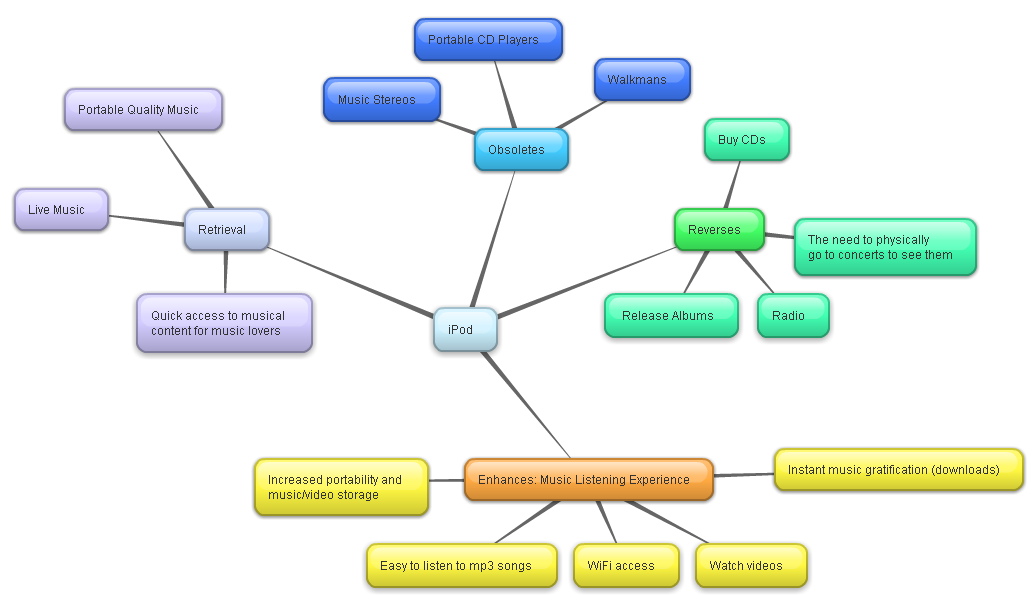
The iPod is the best example of an mp3 player which creates an audio
evolution that improves the aesthetic and musical quality with portability and
instant musical gratification. It enhances the musical experience through
instant downloads, portability, visual and/or auditory musical experience. This
device reverses the need for buying CDs, releasing complete albums, or the need
to go to a concert to see the video. iPods make portable CD players, music
stereos, and walkmans’ among other audio technologies. It retrieves/rekindles the
idea of live music but makes this experience portable. In the future portable
devices with audio and visual elements may range from bionic implants to tiny
nanotechnology devices that relay the information to the brain.
Sunday, January 1, 2012
Sunday, November 13, 2011
Impact of Technology on Life and Learning
Click on the link here to view my prezi on the impact of technology on life and learning then reflect on the role technology plays in your life as a student and a person. Then think about what is it like to learn online and/or using technology? How is it alike and different than learning in a face to face environment? How can you utilize technology in a balanced way that utilizes the anytime anywhere aspects of online learning with a traditional classroom setting? Create a two paragraph response that discusses the statistics reflected on the videos in the prezi and discuss how technology is shaping your life now and how you plan on using it as a future teacher and learner. Post your response on this blog and then respond to another student in the online mini-course.
Friday, August 26, 2011
Philosophy of Learning Digitally…
“If we teach today as we taught yesterday, we rob our children of tomorrow.” John Dewey
As demonstrated in the idea represented in the quote above, learning is dynamic and changes with the shifts based on changes in society. A seismic shift has taken place over the past decade due to the technological advances that have taken place and their implications for education. Distance and online education has seen enormous growth due to the technological advances that have led to what we now see as web 2.0 tools. Walden University’s success serves as a strong example of an organization that is thriving in this new era of education and technology combining to increase learning opportunities for society. These technology tools can be used in a face-to-face, distance/online, and hybrid/blended learning environments. The big three of educational philosophies of learning (behaviorism, cognitivism, and constructivism) have a presence despite the many changes that have taken place in education due to technology and new philosophies such as connectivism are being proposed to address these changes in learning. With this introduction let us remember what is embodied in a learning theory. Driscoll (2005) states, “A learning theory, therefore, comprise a set of constructs linking observed changes in performance with what is thought to bring about those changes” (p. 9). She summarizes the three components of a theory as, “The results…The means…The inputs.” (p. 9). In other words, what were the results of the experience (change in the performance), what were the means of getting those results (the processes that occurred to get the results), and what were the inputs (what circumstances, experiences, and resources were used in to get the results). With this definition a personal philosophy of learning will be briefly explored based on the impact that technological changes have had on learning in this digital age.
My previous leanings in regards to my philosophy of education has been to agree with the basic premises of cognitivism, however this class has made me rethink this and have found that Vygotsky’s social constructivism is a very way to frame digital learning. A series of illustrations demonstrating Vygotsky’s Zone of Proximal Development and More Knowledgable Others includes the role that computers can play alongside of others in his Social Development Theory is below (Galloway, 2001).
Due to the ability of variations of current educational theories such as Vygotsky’s Social Development Theory, which social constructivism utilizes, I think that current theories at this time still apply, albeit they need to broadened, refined, defined, or explored to take into account the vast changes in technology. In reference to other theories I do not think connectivism is a new learning theory, although it seems to be a sort of evolution of constuctivism. It seems that J.A. Matter’s (2010) seems to summarize it best when she relates connectivism to constructivism, stating, “it is possible to position it as the development of constructivism to the current scenario of the use of technology in education, functioning though as a philosophy of education.” Downes’s epistemology of distributed learning seems to be a great foundation for a future learning theory that can still be formed, however connectivism as described by Siemens seems to be more of an extension or evolution of constructivism rather than a new learning theory, albeit his description and critique of knowledge in our current milieu seems to be relatively accurate. The limitation of connectivism is that it takes our current educational, technological, and societal context and provides a metaphor of a network. It seems like this analogy is on point currently, but the test of a true learning theory is to see if this metaphor and the connectivism learning theory that it hinges upon can withstand the test of time and the inevitable evolution of people, society, technology, and its implications for teaching and learning. Calvani’s statement is justified even if the rest of his critique of connectivism falls short. “A wild transfer of connectivism to school would lead to think that putting students on the net is enough to produce knowledge, thus consolidating that widespread harmful cliché according to which the more technologies we use, anyway we do it, the better it is for learning” (p. 251). My philosophy of learning digitally is constantly being challenged and changing, however utilizing Vygotsky's and social constructivism at this time seems a good foundation for a digital philosophy of learning.
References:
Driscoll, M.P. (2005). Psychology of Learning for Instruction.
Galloway, C. M. (2001). Vygotsky's Constructionism. In M. Orey (Ed.), Emerging perspectives on learning, teaching, amd technology. Retrieved (insert date) from http://projects.coe.uga.edu/epltt/
Learning Theories Knowledgebase (2011, August). Social development theory (Vygotsky) at Learning-Theories.com. Retrieved August 27th, 2011 from http://www.learning-theories.com/vygotskys-social-learning-theory.html
Thursday, August 11, 2011
Adoption of New Technologies and the ARCS model…
“Teachers need to integrate technology seamlessly into the curriculum instead of viewing it as an add-on, an afterthought, or an event.” Heidi Hayes Jacobs
Technology adoption is a challenge for many industries due to its rapid pace and constant evolution. In the education sector technologies are constantly being purported by corporations and organizations as tools to increase student achievement. The reality is that many technologies that are being sold to educational organizations are only as good as the training and implementation strategies that go with technology tools. Teachers are used to trendy initiatives that are not implemented that come and go frequently. There is usually initial resistance by educators concerning new technologies due to the consistent changes that take place on the educational landscape.
In a previous post in an elementary school last year I attempted to share with teachers the use of wikis in the classroom. I shared how I used wikis in my classroom. There was an interest by a few teachers and I attempted to contact the administration to volunteer for doing professional development on the use of wikis in the classroom. The principal was new to his post and was absolutely uninterested in this type of technology training for the staff. Due to the lack of interest that the principal had on using wikis in the classroom the teachers did not receive any training on wikis in the classroom. I changed to a different position in November last year and by February I was training all staff monthly on technologies such as wikis and blogs in the classroom, digital storytelling, podcasting, and cartoon creation. By the end of the June teachers in all the content areas and the technology coordinators in my current settings use wikis in different ways both in and out of the classroom. What was different about the two scenarios? The administration made all the difference.
Following Keller’s ARCS model (see below) in the first situation I could have done the following things and had a different result. First, I could have presented wiki integration in a formal way to first the administration and then the staff about how it could be used in instruction and provided peer-reviewed articles that reinforce the effectiveness of wikis in the classroom across content areas. That would have fulfilled the A (attention) in ARC. The second part is the R (relevance) and I could have provided personal examples of how I use wikis in the classroom, share other stories and examples of how teachers in similar situations use wikis, and conduct a survey of how students in my classroom appreciate wikis and present it to the administration and staff. The third step is C (confidence), and I could have a few teachers be trained and pilot the use of wikis in their classrooms to show the staff and administration how it can be used successfully in the classroom in this setting. Then the second part of C is to train all teachers on creating and maintaining a wiki in the classroom and have them track student survey and student work data to track its effectiveness. The fourth and final step, S (satisfaction), is have the students at the end of the first implementation cycle to reflect on their growth and uses of wikis in their classrooms. If these steps would have been taken there would have been a better likelihood of the administration and teachers motivation to use wikis in the school setting in different ways.
References:
Keller, J.M. (2006). What is the ARCS model? Retrieved from http://www.arcsmodel.com/Mot%20dsgn%20A%20model.htm
Learning Theories Knowledgebase (2011, August). ARCS Model of Motivational Design (Keller) at Learning-Theories.com. Retrieved from http://www.learning-theories.com/kellers-arcs-model-of-motivational-design.html
Image 1 Retrieved from http://www.growthengineering.co.uk/admin/uploads/Arcs%20method%20of%20engagement.png
Image 2 Retrieved from http://idtheory.pbworks.com/f/1271655312/arcs.jpg
Friday, July 29, 2011
Thursday, July 14, 2011
Calling for Collaboration...
I think the span of human history has demonstrated there is a basic instinct to interact and work together as a group. It is as intrinsic to our survival and identity as being recognized as an individual. Both collaboration and individuality are represented in our instinct and in our past. Many times these two basic instincts clash. Our collective history includes cultures continually asking what role does the community and/or government have on the lives of individuals. Each culture balances collective experiences collaboration with individual choices. There is a spectrum of how each culture and country have manifested these two opposite instincts. All of us want to be accepted by a group or community, which is the prerequisite for collaboration. Also each of us wants to be seen as distinct from others in a group or community. Both tendencies have endless demonstrations in both history and educational theory.
Vygotsky, Dewey, Bruner, Piaget, and other prominent constructivists understood the role that social/cultural context play in learning (Driscoll, 2005). The read write web, web 2.0 tools, social networks, professional learning communities (PLC), personal learning networks (PLN), and other evolving tools and relationships demonstrate the strong tendency to collaborate on issues and disciplines. These tools allow for collaboration that happens anywhere at anytime without the limits of time and space. Constructivist principles lend themselves quite easily to these technology tools because of the ease of collaboration that can take place that takes into account the social aspect of learning and collective knowledge. There is a large amount of literature inside and outside of the field of education that demonstrate the role and importance the social aspect of learning is and how collaboration is considered to be an essential skill in both learning and work.
Hughes & Narayan (2009) highlight wikis in their article in The Journal of Interactive Online Learning particular as a way to increase collaboration for postsecondary students. Their study highlighted the use of wikis as a “students used their wiki as a course content glossary for posting and editing original contributions” (Hughes & Narayan, 2009, p. 63) in one course and as a “develop, share, and edit project assignments” (Ibid.) in another course. Faculty in higher education considered curriculum mapping as a great way to collaborate according to Uchiyama & Radin’s article in Innovative Higher Education in 2009, which can be accessed here. Their observations reflect on the lack of collaboration in many Higher Education circles despite the fact that “Organizations beyond higher education have shifted toward cultures where the norms of autonomy and independence are replaced by the norms of collegiality and collaboration” (Uchiyama & Radin, 2009, p. 272). These are two sources that communicate the effectiveness of collaboration and how technology tools can be used in the process of collaboration.
References:
Driscoll, M. P. (2005). Psychology of learning for instruction (3rd ed.). Boston, MA: Pearson Education, Inc.
Hughes, J.E., & Narayan, R. (2009). Collaboration and learning with wikis in post-secondary classrooms. Journal of Interactive Online Learning, 8(1), pp. 63-82. Retrieved from http://www.ncolr.org/jiol/issues/pdf/8.1.4.pdf
Thursday, June 30, 2011
Conversation Concerning Cognitivism…
Cognitivism began as an alternative theory to behaviorism (Hauser, 2005). Driscoll (2005) compares behaviorism with information processing, a form of cognitivism. Driscoll has an advanced organizer that compares the black box metaphor, where environmental stimuli going into the black box and leading to observed behavior, with the computer metaphor, that input, or sensory stimulation, goes through the human cognitive processes and leads to output, or learned capabilities (2005, p. 142). A set of visuals about these theories can be viewed on the side of this blog post that demonstrates aspects of cognitivism.
The most important contribution to learning theory that Computer Information Processing (CIP) theory, schema theory, situated cognition, and Piaget’s cognitive development theory is that the emphasis on the research is focused on how learning occurs within the learner rather than just on the observable behavior that is seen after learning has taken place. Helpful insights from cognitivism that informs teacher pedagogy include the emphasis on activating prior knowledge, anchoring ideas, and organizing knowledge such as in Meaningful Learning and Schema theory, apprenticeships and communities of practice, and focusing on developmental and cognitive stages as in Piaget’s cognitive development theory (Driscoll, 2005).
Any technology that is used in the teaching and learning process can be categorized under a theory. Cognitivism is one theory that uses the analogy of information processing and computers to understand what goes on the human brain as people learn. Therefore cognitivism definitely is connected to technology as sis connectivism and others. Behaviorism is also connected to learning machines but does not attempt to use an analogy of a machine or computer in the learning processs. Whatever the theory, technology should play a prominent role in discussing it because technology is taking a very large place in K-12 and higher education. Kerr (2007) highlights in his blog post that each learning theory, or _ism, “…is offering something useful without any of them being complete or stand alone in their own right.” Kapp (2007) also reinforces this statement in his response, “We need to take pieces from each school of thought and apply it effectively because…Cognitivism doesn’t explain 100% how humans process information and neither does Constructivism or Behaviorism. What we need to is take the best from each philosophy and use it wisely to create solid educational experiences for our learners.” Both perspectives are important and encapsulate much of the realities in educational research and the discussion of learning theories. The learning process is complex and it takes more than one theory to articulate it. Each theory has its place in education and has its application in the classroom. It reminds me of a good quote, "There is nothing so practical as a good theory" (Ludwig Boltzmann, 1844-1906).
References:
Driscoll, M. P. (2005). Psychology of learning for instruction (3rd ed.). Boston, MA: Pearson Education, Inc.
Hauser, L. (2005, July 19). Behaviorism, Internet Encyclopedia of Philosophy. Retrieved from http://www.iep.utm.edu/behavior/
Kerr, B. (2007, January 1). _isms as filter, not blinker [Web log post]. Retrieved from http://billkerr2.blogspot.com/2007/01/isms-as-filter-not-blinker.html
Kapp, K. (2007, January 2). Out and about: Discussion on educational schools of thought [Web log post]. Retrieved from http://www.kaplaneduneering.com/kappnotes/index.php/2007/01/out-and-about-discussion-on-educational/
The most important contribution to learning theory that Computer Information Processing (CIP) theory, schema theory, situated cognition, and Piaget’s cognitive development theory is that the emphasis on the research is focused on how learning occurs within the learner rather than just on the observable behavior that is seen after learning has taken place. Helpful insights from cognitivism that informs teacher pedagogy include the emphasis on activating prior knowledge, anchoring ideas, and organizing knowledge such as in Meaningful Learning and Schema theory, apprenticeships and communities of practice, and focusing on developmental and cognitive stages as in Piaget’s cognitive development theory (Driscoll, 2005).
Any technology that is used in the teaching and learning process can be categorized under a theory. Cognitivism is one theory that uses the analogy of information processing and computers to understand what goes on the human brain as people learn. Therefore cognitivism definitely is connected to technology as sis connectivism and others. Behaviorism is also connected to learning machines but does not attempt to use an analogy of a machine or computer in the learning processs. Whatever the theory, technology should play a prominent role in discussing it because technology is taking a very large place in K-12 and higher education. Kerr (2007) highlights in his blog post that each learning theory, or _ism, “…is offering something useful without any of them being complete or stand alone in their own right.” Kapp (2007) also reinforces this statement in his response, “We need to take pieces from each school of thought and apply it effectively because…Cognitivism doesn’t explain 100% how humans process information and neither does Constructivism or Behaviorism. What we need to is take the best from each philosophy and use it wisely to create solid educational experiences for our learners.” Both perspectives are important and encapsulate much of the realities in educational research and the discussion of learning theories. The learning process is complex and it takes more than one theory to articulate it. Each theory has its place in education and has its application in the classroom. It reminds me of a good quote, "There is nothing so practical as a good theory" (Ludwig Boltzmann, 1844-1906).
References:
Driscoll, M. P. (2005). Psychology of learning for instruction (3rd ed.). Boston, MA: Pearson Education, Inc.
Hauser, L. (2005, July 19). Behaviorism, Internet Encyclopedia of Philosophy. Retrieved from http://www.iep.utm.edu/behavior/
Kerr, B. (2007, January 1). _isms as filter, not blinker [Web log post]. Retrieved from http://billkerr2.blogspot.com/2007/01/isms-as-filter-not-blinker.html
Kapp, K. (2007, January 2). Out and about: Discussion on educational schools of thought [Web log post]. Retrieved from http://www.kaplaneduneering.com/kappnotes/index.php/2007/01/out-and-about-discussion-on-educational/
Subscribe to:
Posts (Atom)