Wednesday, March 14, 2012

Digital Books as a Disruptive Technology


Identify a current technology that has emerged in the last few years that shapes learning or productivity in your industry.



According to Walton and Oestreicher’s (2011) presentation at the Eurasia Business and Economics Society’s Conference in June of 2011, accessed here, eBooks have just become “the single bestselling category in American publishing for the first time. The report from the Association of American Publishers also said that eBook sales in February were $90.3m, making digital book the largest single format in the U.S. for the first time” (p. 14). The reason for this disruption can be attributed to the rapid rise in netooks, tablets, and other mobile devices that very quickly proliferated throughout our society, as Reynolds & Ioffe’s (2011) have highlighted on the xplana blog post here. There projections for sales of digital textbooks can be seen on the chart. These and other important discussions about the role of eBooks as a disruptive technology, provide enough evidence that supports the fact that it is an emerged that eBooks/digital books are a disruptive technology in the education and publishing industries.


   What problems or challenges have been associated with this technology?

The biggest barriers to textbook adoption have been the devices and formats that the digital books would be displayed on as well as the availability, distribution, and production of digital book content (Reynolds & Ioffe, 2011). The rapid adoption of Apple’s iPad, Amazon’s Kindle, and Barnes and Noble’s Nook among others in the tablet/eReader landscape has created a technological landscape that has mitigated these barriers to adoption because the devices and formats have been more or less created to cross platforms and devices. This has been the reason why this technological innovation has been so disruptive to publishing and educational industries.

  What societal need does it meet, and what are its benefits?

Our current societal milieu has an increasing desire to have their hobbies/interests/entertainment be as mobile as they are in addition to the need to be digitally connected socially. The proliferation of digital devices such as tablets, smartphones, and netbooks has been created to meet this desire. The benefits of having any eBook that can be stored in the “cloud” of the Internet and be instantly pulled up at the whim of the reader has physical and psychological benefits. The physical benefits include the ability to have the reader’s entire library of books in digital storage so that they do not need to be physically carried around to be enjoyed at any time. The psychological benefits of searching books and downloading them for a cheap price any time there is an Internet connection is the ultimate satisfaction for the curious and intrigued reader. Both of these and other benefits serve the wants of the readers and the pocketbooks of the businesses providing these services. It is an inevitable result of our consumeristic and capitalistic ideals; instant gratification for a price that is right is considered a societal want which perceived as a need. Publishing companies must be able to provide this service if they are going to remain viable in our technologically savvy society. Companies that cannot provide this service, such as Borders, for example, will have to shutter their doors or downsize. This will make room for new technology-driven companies that can seize the moment and become an important player in the eBook market, such as Inkling, the up and coming digital textbook company and its Apps.


 What would make this technology even better, avoiding the pitfalls you identified?

I think that eBooks and devices will continue to flourish and that libraries and other institutions must adapt to these emerging needs in order to remain relevant. The biggest challenges will include protecting copyrights, making eBook formats that can be accessed from multiple platforms and devices without sacrificing the visual needs of reading. Google and Amazon are among the companies who are able to meet these challenges at the moment, and other companies will also focus their research and development to make sure that they are able to compete. 


References

Reynolds, R., & Ioffe, Y. (2011, March). Digital textbook sales in U.S. higher education – a five-year projection. The Xplanation. Retrieved from http://blog.xplana.com/reports/digital-textbook-sales-in-u-s-higher-education-%E2%80%93-a-five-year-projection/

Walton, N., & Oestricher, K. (2011, June). Google and Apple’s Gale of Creative Destruction. Presentation presented at the Eurasia Business and Economics Society, Istanbul, Turkey. Retrieved from http://worc.academia.edu/KlausOestreicher/Papers/770458/Google_and_Apples_Gale_of_Creative_Destruction.

Thursday, January 19, 2012

Storytelling goes Digital and the Future of the Web...


Dr. Thornburg’s idea of the rhymes of history basically states that many modern technological innovations echo previous ideas, experiences, and/or cultural interactions from humanity’s past. Digital storytelling through voicethread.com, storybird.com, or iPad apps such as StoryLines all attempt to captivate the visual, auditory, and textual elements of storytelling. The format for exchanging stories has changed throughout the years; however the purpose of the stories remains as a collective approach to share the human experience. Digital storytelling attempts to engage as many senses as possible as a way to recreate in a sense the storytelling around a fire among family, friends, and/or communities.

Kevin Kelly’s extrapolation of where the web is going in his TED Talk “The next 5,000 days of the web” here describes what it is evolving into a single, global machine and the web is its OS (operating system). All of us together make up this machine and the web, which has artificial intelligence but it is in and of itself not a singular consciousness or entity, rather it is made up of all of the people and things that are connected to it. He also contends that we will become codependent on this Web as we are currently dependent on the alphabet and writing. Instead of an alternate reality, this emerging web combines physical reality with digital reality. Kelly reverses McLuhan’s statement “Machines are the extensions of the human senses” to “humans are now going to be the extended senses of the machine”. These ideas reinforce the connections, consciousness, and collective consciousness of humanity and its perception of how it sees itself as a collective, interactive, and dominant force in the natural world. 

References:

Kelly, K. (2007, December). Kevin Kelly on the next 5,000 days of the Web [Speech]. Speech delivered at the EG 2007 Conference, Los Angeles. Retrieved fromhttp://www.ted.com/index.php/talks/kevin_kelly_on_the_next_5_000_days_of_the_web.html

Sunday, January 1, 2012

Audio Tetrad: iPod


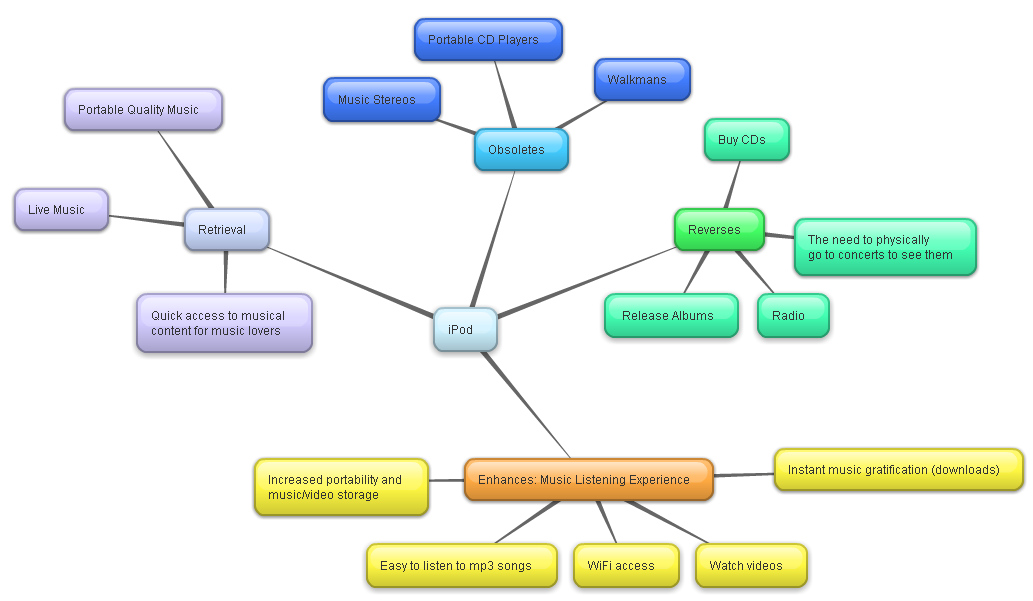
The iPod is the best example of an mp3 player which creates an audio evolution that improves the aesthetic and musical quality with portability and instant musical gratification. It enhances the musical experience through instant downloads, portability, visual and/or auditory musical experience. This device reverses the need for buying CDs, releasing complete albums, or the need to go to a concert to see the video. iPods make portable CD players, music stereos, and walkmans’ among other audio technologies. It retrieves/rekindles the idea of live music but makes this experience portable. In the future portable devices with audio and visual elements may range from bionic implants to tiny nanotechnology devices that relay the information to the brain.  


Sunday, November 13, 2011

Impact of Technology on Life and Learning

Click on the link here to view my prezi on the impact of technology on life and learning then reflect on the role technology plays in your life as a student and a person. Then think about what is it like to learn online and/or using technology? How is it alike and different than learning in a face to face environment? How can you utilize technology in a balanced way that utilizes the anytime anywhere aspects of online learning with a traditional classroom setting? Create a two paragraph response that discusses the statistics reflected on the videos in the prezi and discuss how technology is shaping your life now and how you plan on using it as a future teacher and learner. Post your response on this blog and then respond to another student in the online mini-course.

Friday, August 26, 2011

Philosophy of Learning Digitally…


“If we teach today as we taught yesterday, we rob our children of tomorrow.” John Dewey

As demonstrated in the idea represented in the quote above, learning is dynamic and changes with the shifts based on changes in society. A seismic shift has taken place over the past decade due to the technological advances that have taken place and their implications for education. Distance and online education has seen enormous growth due to the technological advances that have led to what we now see as web 2.0 tools. Walden University’s success serves as a strong example of an organization that is thriving in this new era of education and technology combining to increase learning opportunities for society. These technology tools can be used in a face-to-face, distance/online, and hybrid/blended learning environments. The big three of educational philosophies of learning (behaviorism, cognitivism, and constructivism) have a presence despite the many changes that have taken place in education due to technology and new philosophies such as connectivism are being proposed to address these changes in learning. With this introduction let us remember what is embodied in a learning theory. Driscoll (2005) states, “A learning theory, therefore, comprise a set of constructs linking observed changes in performance with what is thought to bring about those changes” (p. 9). She summarizes the three components of a theory as, “The results…The means…The inputs.” (p. 9). In other words, what were the results of the experience (change in the performance), what were the means of getting those results (the processes that occurred to get the results), and what were the inputs (what circumstances, experiences, and resources were used in to get the results). With this definition a personal philosophy of learning will be briefly explored based on the impact that technological changes have had on learning in this digital age.

My previous leanings in regards to my philosophy of education has been to agree with the basic premises of cognitivism, however this class has made me rethink this and have found that Vygotsky’s social constructivism is a very way to frame digital learning. A series of illustrations demonstrating Vygotsky’s Zone of Proximal Development and More Knowledgable Others includes the role that computers can play alongside of others in his Social Development Theory is below (Galloway, 2001).


Due to the ability of variations of current educational theories such as Vygotsky’s Social Development Theory, which social constructivism utilizes, I think that current theories at this time still apply, albeit they need to broadened, refined, defined, or explored to take into account the vast changes in technology. In reference to other theories I do not think connectivism is a new learning theory, although it seems to be a sort of evolution of constuctivism. It seems that J.A. Matter’s (2010) seems to summarize it best when she relates connectivism to constructivism, stating, “it is possible to position it as the development of constructivism to the current scenario of the use of technology in education, functioning though as a philosophy of education.” Downes’s epistemology of distributed learning seems to be a great foundation for a future learning theory that can still be formed, however connectivism as described by Siemens seems to be more of an extension or evolution of constructivism rather than a new learning theory, albeit his description and critique of knowledge in our current milieu seems to be relatively accurate. The limitation of connectivism is that it takes our current educational, technological, and societal context and provides a metaphor of a network. It seems like this analogy is on point currently, but the test of a true learning theory is to see if this metaphor and the connectivism learning theory that it hinges upon can withstand the test of time and the inevitable evolution of people, society, technology, and its implications for teaching and learning. Calvani’s statement is justified even if the rest of his critique of connectivism falls short. “A wild transfer of connectivism to school would lead to think that putting students on the net is enough to produce knowledge, thus consolidating that widespread harmful cliché according to which the more technologies we use, anyway we do it, the better it is for learning” (p. 251). My philosophy of learning digitally is constantly being challenged and changing, however utilizing Vygotsky's and social constructivism at this time seems a good foundation for a digital philosophy of learning. 

References:

Driscoll, M.P. (2005). Psychology of Learning for Instruction.

Galloway, C. M. (2001). Vygotsky's Constructionism. In M. Orey (Ed.), Emerging perspectives on learning, teaching, amd technology. Retrieved (insert date) from http://projects.coe.uga.edu/epltt/

Learning Theories Knowledgebase (2011, August). Social development theory (Vygotsky) at Learning-Theories.com. Retrieved August 27th, 2011 from http://www.learning-theories.com/vygotskys-social-learning-theory.html

Mcleod, S.A. (2007). Vygotsky. Retrieved from http://www.simplypsychology.org/vygotsky.html.

Thursday, August 11, 2011

Adoption of New Technologies and the ARCS model…

“Teachers need to integrate technology seamlessly into the curriculum instead of viewing it as an add-on, an afterthought, or an event.” Heidi Hayes Jacobs

Technology adoption is a challenge for many industries due to its rapid pace and constant evolution. In the education sector technologies are constantly being purported by corporations and organizations as tools to increase student achievement. The reality is that many technologies that are being sold to educational organizations are only as good as the training and implementation strategies that go with technology tools. Teachers are used to trendy initiatives that are not implemented that come and go frequently. There is usually initial resistance by educators concerning new technologies due to the consistent changes that take place on the educational landscape.

In a previous post in an elementary school last year I attempted to share with teachers the use of wikis in the classroom. I shared how I used wikis in my classroom. There was an interest by a few teachers and I attempted to contact the administration to volunteer for doing professional development on the use of wikis in the classroom. The principal was new to his post and was absolutely uninterested in this type of technology training for the staff. Due to the lack of interest that the principal had on using wikis in the classroom the teachers did not receive any training on wikis in the classroom. I changed to a different position in November last year and by February I was training all staff monthly on technologies such as wikis and blogs in the classroom, digital storytelling, podcasting, and cartoon creation. By the end of the June teachers in all the content areas and the technology coordinators in my current settings use wikis in different ways both in and out of the classroom. What was different about the two scenarios? The administration made all the difference.

Following Keller’s ARCS model (see below) in the first situation I could have done the following things and had a different result. First, I could have presented wiki integration in a formal way to first the administration and then the staff about how it could be used in instruction and provided peer-reviewed articles that reinforce the effectiveness of wikis in the classroom across content areas. That would have fulfilled the A (attention) in ARC. The second part is the R (relevance) and I could have provided personal examples of how I use wikis in the classroom, share other stories and examples of how teachers in similar situations use wikis, and conduct a survey of how students in my classroom appreciate wikis and present it to the administration and staff. The third step is C (confidence), and I could have a few teachers be trained and pilot the use of wikis in their classrooms to show the staff and administration how it can be used successfully in the classroom in this setting. Then the second part of C is to train all teachers on creating and maintaining a wiki in the classroom and have them track student survey and student work data to track its effectiveness. The fourth and final step, S (satisfaction), is have the students at the end of the first implementation cycle to reflect on their growth and uses of wikis in their classrooms. If these steps would have been taken there would have been a better likelihood of the administration and teachers motivation to use wikis in the school setting in different ways.


References:

Keller, J.M. (2006). What is the ARCS model? Retrieved from http://www.arcsmodel.com/Mot%20dsgn%20A%20model.htm

Learning Theories Knowledgebase (2011, August). ARCS Model of Motivational Design (Keller) at Learning-Theories.com. Retrieved from http://www.learning-theories.com/kellers-arcs-model-of-motivational-design.html


Image 2 Retrieved from http://idtheory.pbworks.com/f/1271655312/arcs.jpg